Indoor playground cleaning schedule: daily and weekly
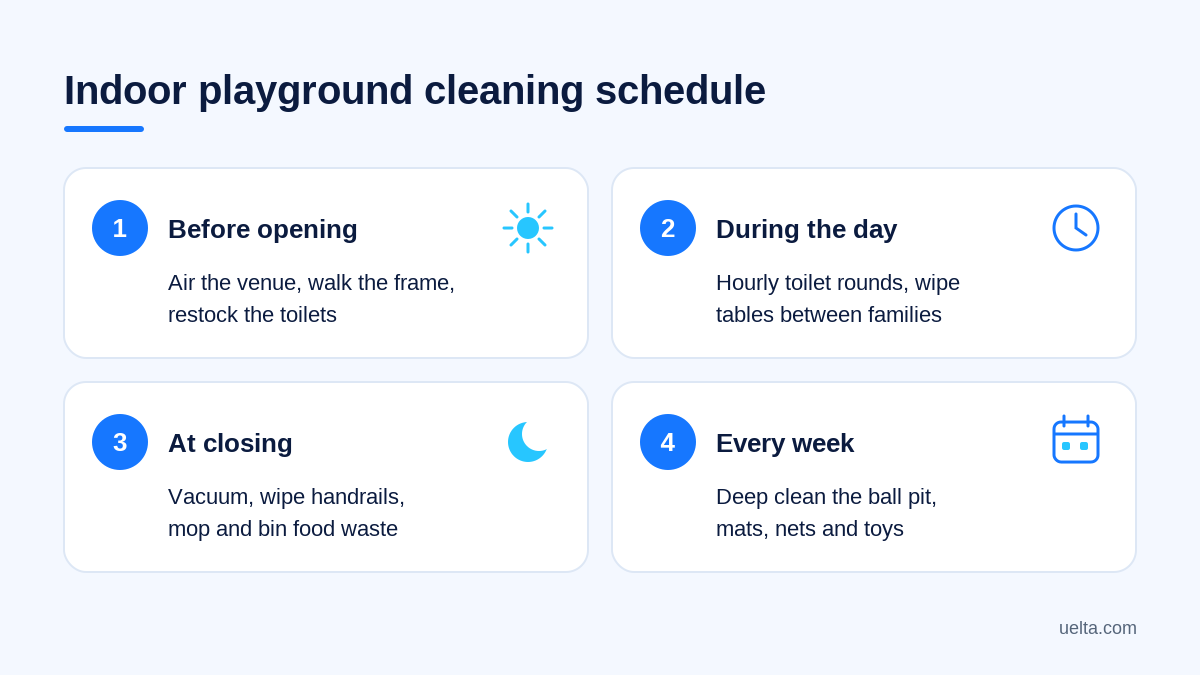
An indoor playground cleaning schedule works when it is split into four fixed moments: before opening, during the day, at closing and once a week, each with its own checklist and a named person. Anything touched constantly or likely to end up in a child's mouth is cleaned daily; nets, mats and the ball pit get a deep clean every week.
Building your indoor playground cleaning schedule by zone
Before setting times, split the venue by risk, not by floor area. Ask two questions about every corner: how many hands touch it each hour, and could it end up in a child's mouth? That gives you four zones:
- Critical zone: toilets, baby changing, toddler area, café and party tables, water fountains and entrance handrails. Checked several times a day.
- Play zone: the frame, slides, ball pit, mats and panels. Daily wipe-down and weekly deep clean.
- Circulation zone: reception, shoe racks, lockers, corridors and party rooms. Cleaned daily and after every party.
- Technical zone: stockroom, cleaning cupboard, vents and filters. Checked weekly or as often as the manufacturer or your maintenance contractor advises.
Put a colour-coded floor plan in the cleaning cupboard with the frequency written next to each zone. A new starter in the school holidays grasps the priorities in a minute, without anyone having to explain it on a packed Saturday.
Daily routine: before opening, during the day and at closing
Before opening
- Air the building during your walk-round: doors open, ventilation on.
- Walk the frame from top to bottom looking for food, lost property and torn covers.
- Check toilets and changing areas: paper, soap, hand gel, nappy bags and empty bins.
- Wipe tables, chairs and high chairs in the eating area.
- Make sure the cleaning trolley is fully stocked and out of children's reach.
During the day
- Toilet rounds at a fixed interval, for example every hour and always after a session change, with the time and initials on the sheet by the door.
- Eating tables cleaned between one family and the next, not at the end of the afternoon.
- Toddler area: mouthed toys go into a 'to wash' box and are swapped for clean ones, rather than being wiped in a hurry in front of parents.
- Vomit and toileting accidents: close the area, remove with absorbent material, clean, disinfect respecting the product's contact time, then reopen. Ideally not the person serving food at that moment.
- Party rooms: full clean between parties. Build that gap in when you plan the day's parties; if they run back to back, cleaning is the first thing to be skipped.
At closing
- Vacuum the frame floors, ramps and the surface of the ball pit.
- Clean contact surfaces: grab handles, nets at hand height, slides and handrails.
- Mop the main floor, toilets and eating area.
- Empty bins and take out food waste: it should not stay inside overnight.
- Note anything left undone and any damage, for the morning shift.
Weekly routine and deep cleaning
Choose your quietest day and share the heavy jobs between several people:
- Ball pit: empty it section by section, remove cracked or sticky balls, vacuum the base and wash the balls using a method the manufacturer allows.
- Mats and covers: both sides and the seams, where dirt builds up; check zips and Velcro.
- Nets and tubes: brush the high levels the daily wipe-down cannot reach.
- Shoe racks, lockers and toddler toys: racks and lockers inside, where socks and wrappers get left, and a full wash of every toy.
- Cleaning cupboard: tidy up, check expiry dates and count products for the next order.
Put dates in the diary for monthly or quarterly jobs, such as cleaning the upper levels of the frame or the ventilation grilles. And keep cleaning and maintenance apart: a torn net or loose panel found while cleaning is logged as an incident, the area is closed and it stays closed until it is repaired.
Products, safety data sheets and protecting your staff
The right product matters as much as the frequency:
- Ask the frame manufacturer which products suit its materials; some disinfectants damage PVC and covers.
- Read the label: dilution, contact time and whether rinsing is needed. Spraying and wiping straight away does not disinfect.
- Keep safety data sheets accessible and show the team where they are.
- Never mix products, and use labelled spray bottles, never old drinks bottles.
- Colour-coded cloths (one colour for toilets, another for tables) so dirt does not travel between zones.
- Gloves and, where the data sheet says so, other protection for whoever is cleaning.
Hygiene, health and safety and biocide rules vary by country, region and product. Check your situation with your health and safety adviser and a legal adviser.
Who cleans and how you check it
'Everyone does it' usually ends with nobody doing it. Assign each task to a specific shift role (opening, floor, reception, closing) and write down who supervises:
- One sheet per zone with tasks, planned time and space for initials.
- The duty manager spot-checks two or three points and signs off.
- At closing, anything outstanding is handed over in writing, not verbally.
- Once a month, review customer complaints about cleanliness and adjust frequencies.
Mistakes to avoid:
- Only cleaning the toilets when someone complains.
- Filling in the log at the end of the day from memory.
- Leaving the cleaning trolley unattended in the play area.
- Training new staff with a quick chat instead of a written procedure.
Frequently asked questions
How often should a ball pit be cleaned?
As a starting point, a surface clean every evening and a weekly deep clean, emptied section by section. Bring it forward after a very busy day or an incident, and always follow the manufacturer's guidance.
What should I use to disinfect soft play mats?
A product compatible with the material, as confirmed by the frame manufacturer, and approved for that use. Follow the dilution and contact time on the label.
Can you clean soft play while children are inside?
Quick spot cleans, yes, with that area closed off. Cleaning with chemicals and deep cleans should happen with no children present, before opening or after closing.
Do I need to keep a written cleaning log?
It is strongly advisable, because it shows what is being done and helps you spot gaps. Specific requirements depend on your activity and location, so check with an adviser.
How Uelta helps
Uelta will not do the cleaning, but it organises everything around the routine. In internal operations you record customer complaints about cleanliness in seconds, with an owner, compensation and closure, and the statistics show what keeps coming up. You can also log incidents with photos, run maintenance in six steps from request to sign-off, and track stock by storeroom with alerts linked to supplier orders, which helps you avoid running out of cleaning supplies.
With Staff and HR you upload your cleaning procedure with attachments or video; the team reads and signs it on their phones, and you see who is missing and download the PDF with the signatures. These are optional modules you switch on from the dashboard only if you need them. To see everything Uelta does for venues like yours, visit indoor playgrounds.
Try it with your own venue: start your 7-day free trial.